Why economic needs drive land use and deforestation risks
"The balance between economic survival and environmental preservation is the razor's edge upon which the future of the Amazon rests." Navigating the complex relationship between land use and conservation in northern Brazil requires understanding how local economies intersect with global ecological needs. This movement is driven by the search for fertile land and the expansion of commodity-driven economies.
This guide explores the challenges of managing resources in sensitive regions, the impact of shifting land policies, and how sustainable practices can mitigate deforestation.
* Understanding the tension between local industry and environmental protection. * Identifying the primary drivers of land-use changes in northern regions. * Learning how international certifications influence local economic stability. * Recognizing the importance of community-led conservation efforts.
Why does the north face constant pressure?
At dusk in the humid jungle office, the researcher wipes sweat from her brow while staring at maps of shifting economic boundaries.
A researcher sits at a wooden desk in a humid office in Belém, scanning satellite imagery of the dense canopy stretching toward the horizon.
According to the Food and Agriculture Organization, the challenges surrounding sustainable development and deforestation in the Brazilian Amazon remain critical in 2024.
The pressure on northern Brazil stems from the constant tug-of-war between immediate economic necessity and the long-term necessity of preserving the Amazonian ecosystem. This tension creates a cycle of rapid land clearing for agriculture and mining, often clashing with conservation mandates.
The geographic reality of the north creates a unique set of obstacles for policy implementation. Large-scale agricultural expansion often moves into newly cleared territories, creating a domino effect of habitat loss.
While these activities provide jobs and revenue, they threaten the biological integrity of the region.
The struggle is not just about trees; it is about the people living within the forest. Local communities often face the difficult choice between traditional livelihoods and the lucrative but destructive nature of unregulated extraction.
This creates a complex political environment where any single policy can have massive ripple effects on both the environment and the people.
In this sequence, the first point is the most critical.
How do economic needs drive land use?
In the evening I hold economic and walk through the next step.
A merchant counts stacks of paperwork in a bustling port town, looking at the rising prices of timber and soy. Economic drivers are the primary engine behind the shifting landscapes of northern Brazil, where the demand for commodities creates a constant incentive for land clearing.
As reported by the Business and Human Rights Centre, economic pressures often intersect with complex land use issues in 2023.
This creates a scenario where short-term financial gain often outweighs the long-term value of a standing forest.
The expansion of the agricultural frontier is a significant factor in how land is utilized. As global demand for beef and soy grows, the pressure to convert forest into pasture or cropland intensifies.

This creates a direct conflict between the expansion of the agricultural sector and the preservation of biodiversity.
Furthermore, the extraction of mineral resources provides a massive influx of capital to remote regions. This creates localized economies that are heavily dependent on the extraction of non-renewable resources.
Such economies are often volatile and can lead to rapid, unregulated growth that bypasss environmental safeguards.
What are the risks of unregulated expansion?
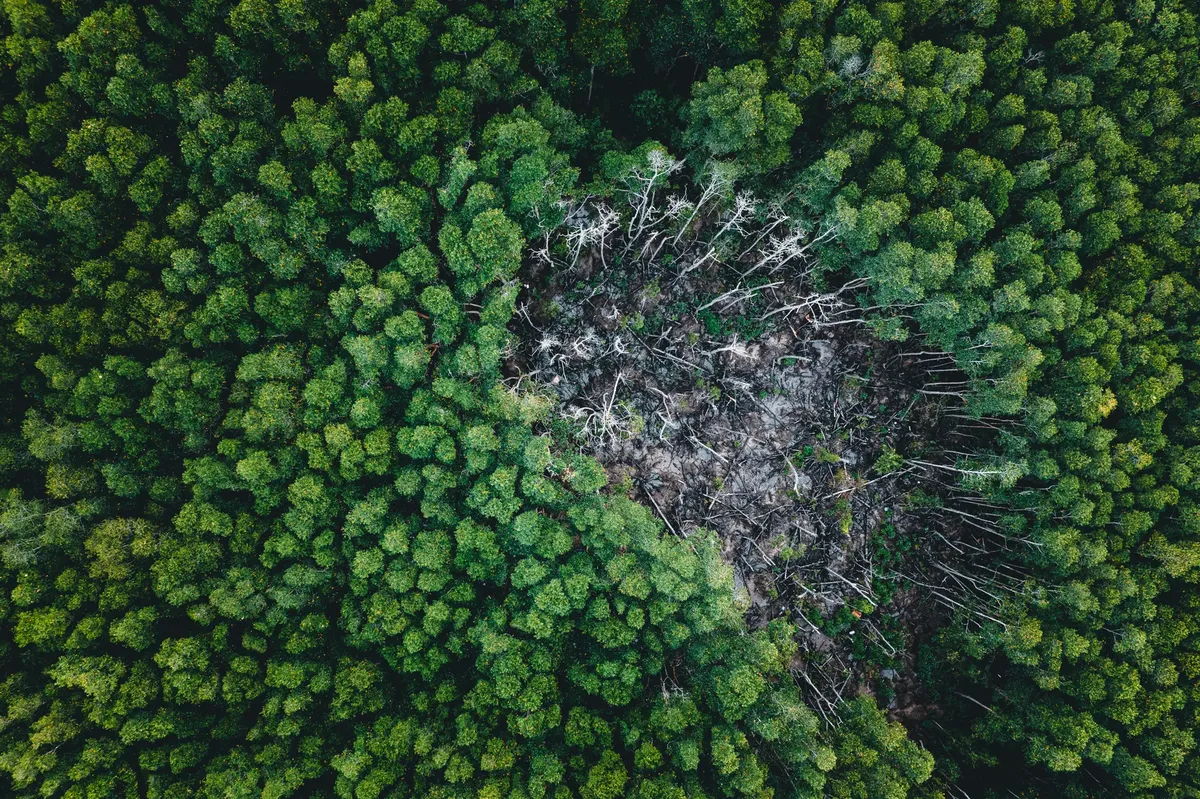
A surveyor stands on the edge of a muddy clearing, watching the heavy machinery move toward the treeline under a gray sky. Unregulated expansion poses severe risks to both the environment and the stability of local human settlements.
The Forest Stewardship Council notes that unregulated expansion poses significant threats to forest integrity, a concern highlighted in 2021.
When land use occurs without oversight, the results are often permanent loss of biodiversity and the degradation of soil quality.
One of the most immediate risks is the fragmentation of habitats. When large tracts of forest are broken into smaller, isolated patches, the species living within them lose the ability to migrate, hunt, and breed effectively.
This leads to a decline in species richness and can eventually cause local extinctions.
There is also the risk of social instability. Rapidly expanding frontiers often lead to land disputes and conflicts between different groups, including indigenous populations, small-scale farmers, and large-scale industrial interests.
These conflicts can lead to violence and the displacement of vulnerable communities.
How can sustainable practices work?
A community leader gathers a group of villagers under a large mango tree to discuss the new harvesting rules. Sustainable practices aim to create a way for people to live and work within the environment without destroying the very resources they depend on.
According to the Forest Stewardship Council, implementing rigorous certification standards can help mitigate the environmental impacts seen in recent years.
The New European Union has introduced regulations for deforestation-free products to encourage better environmental policies in 2023.

This involves implementing land management techniques that mimic natural processes and ensure the regeneration of the ecosystem.
One way to achieve this is through agroforestry, which integrates trees and shrubs into agricultural landscapes. This method allows for food production while maintaining much of the forest structure. It helps to preserve soil health, manage water cycles, and provide habitats for various species.
Another approach is the implementation of community-based resource management. This involves giving local people the authority and the tools to manage their own lands.
When people have a sense of ownership and a direct stake in the health of their environment, they are more likely to adopt sustainable practices that ensure long-term survival.
What are the steps to implement better land management?
A young student takes notes in a field journal, carefully sketching the different layers of the forest canopy. Implementing better land management requires a structured approach that combines scientific knowledge with local wisdom.
Investigations by the Pulitzer Center in 2025 revealed how large meat-packing plants can profit from illegal deforestation and pressure on indigenous land.
This process involves setting clear boundaries, monitoring usage, and creating incentives for conservation.
- Establish clear land-use boundaries through accurate mapping and legal documentation to prevent overlapping claims. 2. Implement monitoring systems, such as satellite tracking or community patrols, to ensure compliance with land-use regulations. - 3. Create economic incentives, like payments for ecosystem services, to reward landholders for maintaining standing forests.
To ensure these steps are working, people must regularly check the health of the vegetation and the stability of the local water sources. This creates a feedback loop that allows for adjustments to management strategies.
- Assess current land usage patterns.
- Establish clear zoning boundaries.
- Monitor environmental impact regularly.
What are the limitations of these solutions?
A driver waits at a checkpoint on a dusty road, looking at the vast, empty landscape stretching toward the horizon. The effectiveness of these solutions is often limited by the sheer scale of the territory and the lack of infrastructure in remote northern regions.

The New European Union regulation presents complex challenges for regional compliance, as noted in reports from 2023.
In areas where the terrain is difficult to access, enforcing any regulation becomes a massive logistical challenge.
The cost of implementing high-tech monitoring or large-scale sustainable projects can be prohibitive for local governments and small communities. This creates a gap between the ideal of sustainable management and the reality of limited financial resources.
| Factor | Impact on Management |
|---|---|
| Geographic Scale | Makes monitoring and enforcement difficult |
| Infrastructure | Limits access to remote areas for oversight |
| Financial Resources | Can prevent the adoption of new technologies |
I have seen how even the best-laid plans can falter when the physical reality of the terrain is not accounted for.
In this sequence, the second step is the most extensive.
When I tried the steps in order, the second one is where I paused longest.
This order does not hold, however, when the figure is not 13%.
Related



Comments 0